The most important BlackKnightController rule is simple:
prompt -> Codex -> BKC pipeline
The prompt starts the work. Codex helps investigate, reason, template, and repair. But the finished result must land back in the BlackKnightController pipeline.
If a command only lived in an SSH session, it was diagnostic evidence. It was not the finished automation.
Why this rule exists
Infrastructure work has a trap: a human and an assistant can fix a system once and still fail to improve the environment.
That happens when the useful discovery disappears into shell history:
- the PXE exception that had to be MAC-scoped;
- the BIOS setting that changed the boot path;
- the installer argument that made Debian behave;
- the post-install validation that proved Horizon or Proxmox was actually usable;
- the edge proxy rule that made the service reachable from the operator side.
BlackKnightController treats those discoveries as pipeline material.
The pipeline should capture:
- the action;
- the target;
- the guardrail;
- the known-good fragment;
- the validation check;
- the evidence link or receipt.
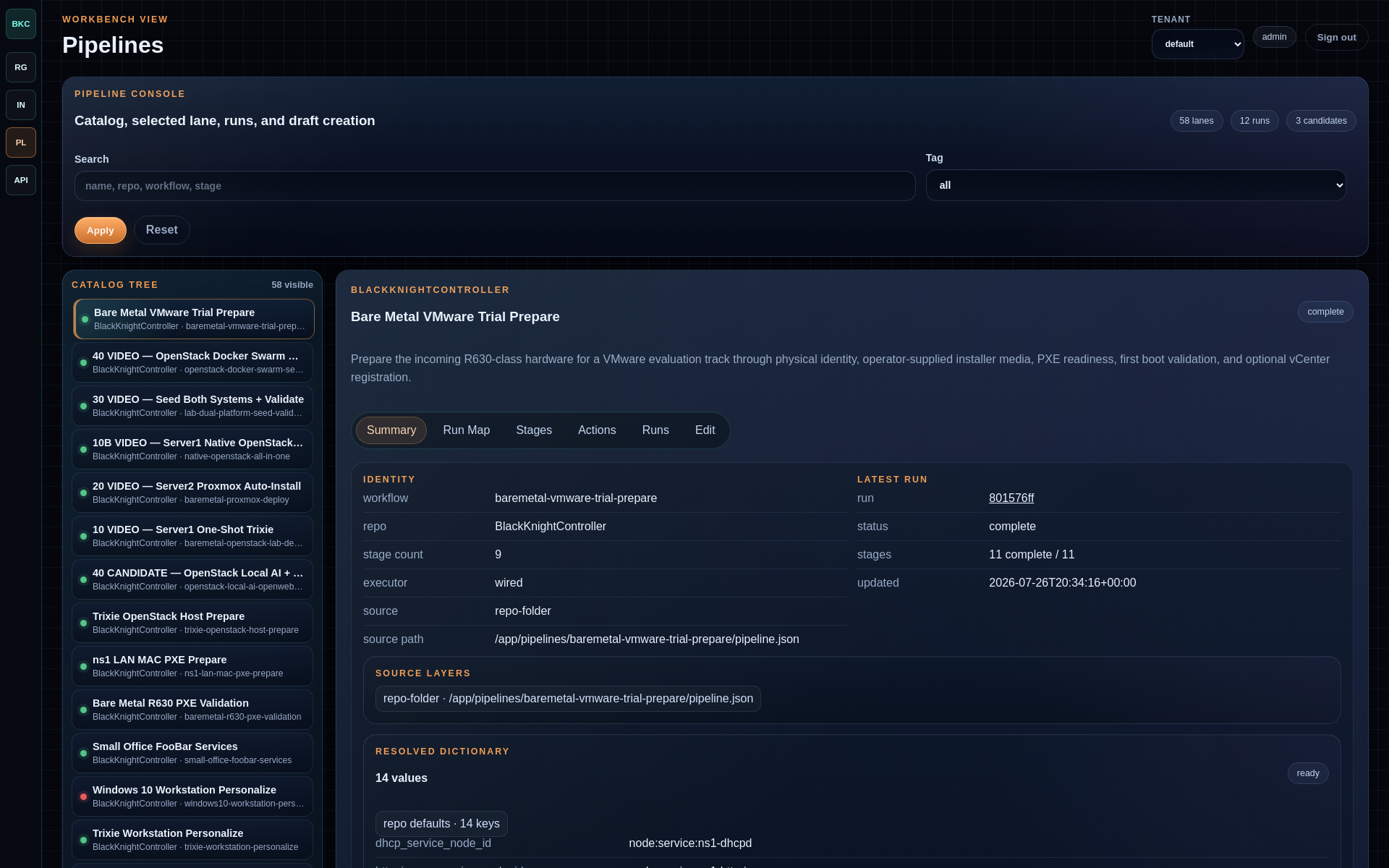
The pipeline workbench is where that contract becomes visible. A pipeline is not just a name in a list; it carries source layers, resolved dictionary values, latest run status, stage maps, actions, and run history. That gives the operator and the assistant the same object to reason about.
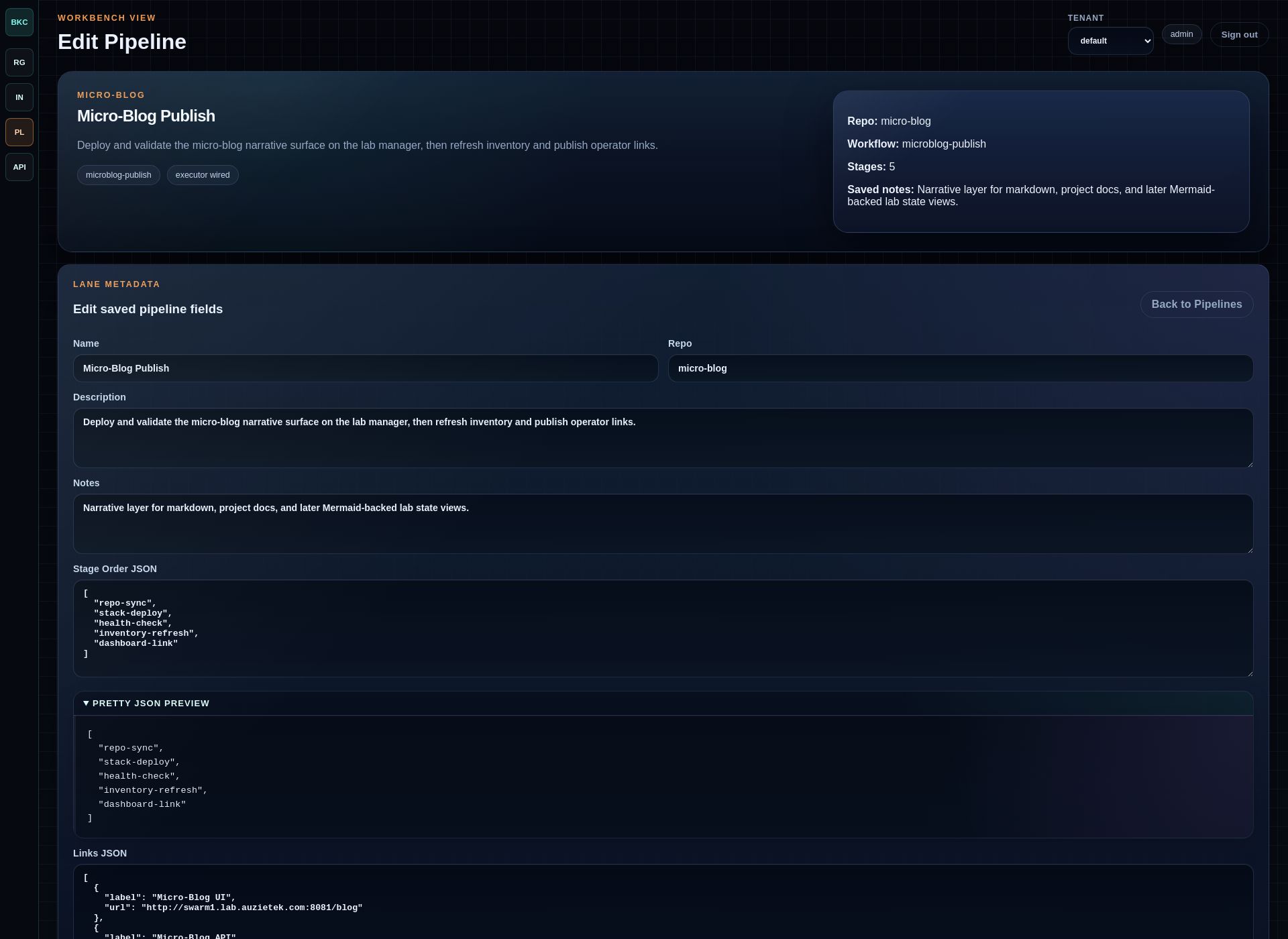
The edit/detail view is where the pipeline becomes maintainable instead of mysterious. JSON fields, stage definitions, notes, links, and dashboards need to be readable enough that an engineer can review them quickly and an assistant can reuse them without drifting into guesswork.
That is how a messy lab session becomes a better next run.
What the recent runs proved
The lab sequence exercised the full control path:
- iDRAC/IPMI power control;
- exact-MAC PXE boot lanes;
- Debian Trixie bare-metal provisioning;
- OpenStack and Proxmox rebuilds;
- ESXi installer handoff and post-install control;
- Docker Swarm seeding on OpenStack and ESXi guests;
- edge URLs, Grafana, Portainer, and resource graph visibility.
The important part is not that every step was perfect the first time. The important part is that the failures produced better fragments.
Once a Debian PXE lane was known good, it needed to be protected. Once the ESXi VM clone pattern worked, it became a reusable workload seed. Once a broad PXE listener was risky, PXE became deny-by-default with exact target exceptions.
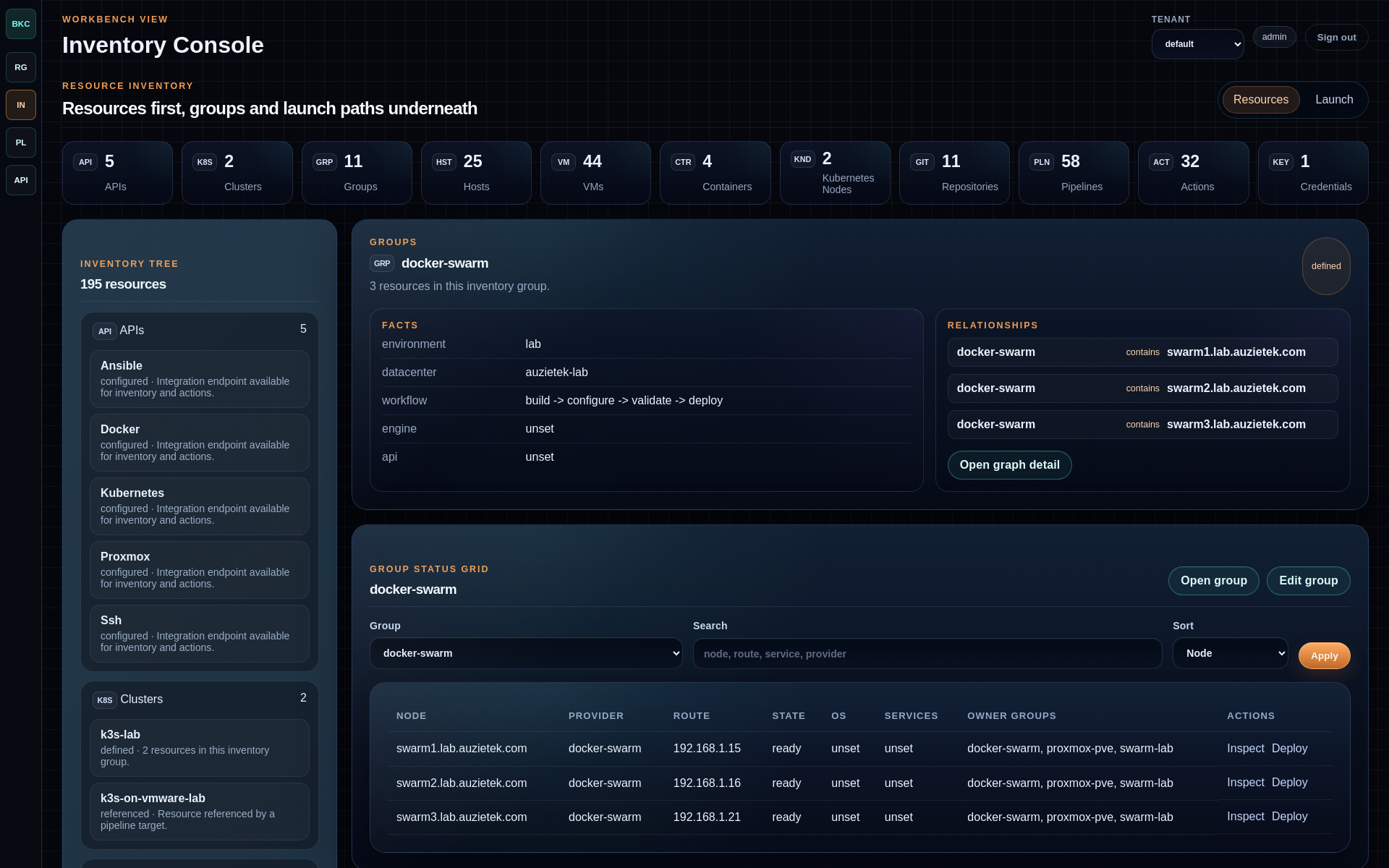
The same pattern applies to inventory. Hosts, groups, VMs, clusters, APIs, containers, pipelines, actions, and credentials should not live in separate mental drawers. BKC keeps them close enough that a pipeline can explain what it touches and why.
The product direction
BlackKnightController is not trying to replace every infrastructure tool. It is trying to connect the useful control surfaces that already exist:
- power control;
- boot intent;
- installer payloads;
- SSH and API actions;
- generated scripts and templates;
- network and DNS updates;
- validation and evidence capture.
That combination lets a small team treat physical infrastructure more like a repeatable deployment target.
The magic is not that an AI assistant can type commands quickly. The magic is that the useful commands become part of an operational memory the next run can trust.